Craig Jointz: “Honey”
OMG, this joint bumps…
Craig Reads: Still So Excited

I kindled this book after seeing Ruth—the deep-voiced Pointer Sister who slayed “Automatic”—on Wendy Williams. The book instantly had me hooked with its wild, riveting tales of drinking and drugging.

All of this carrying-on was a surprise to me, because I always thought of the Pointer Sisters, daughters of a pastor, mostly as a tame pop act.

Ruth’s story is one of redemption as she cleans up and finds her way back to God. But the book also details the downfall of the stunning, gap-toothed baby sister, June.


June struggled with sexual abuse, drugs and mental illness since she was a teen, and she spent her final years in a house gutted of the accoutrements of her world-class success, surround by sycophants and armed members of the Crips. The parallel stories of Ruth and June depict life as a game of chance marked by tragedy and grace.

Here are three of my fave, unsung musical moments by the Pointer Sisters. The group was known to rule Top 40, but I prefer the funkier stuff.
1) The best Pointer Sisters’ song/remix you’ve likely never heard
2) The Pinball Count from Sesame Street
3) “You Gotta Believe” from Car Wash
Btw, one of the book’s funniest anecdotes concerns the Pointer Sisters’ Car Wash co-star Richard Pryor. Once, the Pointer Sisters opened for him at a concert in New Jersey. When Richard took the stage after the Pointer Sisters’ performance, he said: “How about those fabulous Pointer Sisters? Those girls can sing, can’t they? But they just won’t give me no pussy!”

Renaissance Bey

Carlo Francesco Nuvolone (Italian, 1609-1662). ‘Madonna and Child,’ ca. 1620-1662. oil on canvas. Walters Art Museum (37.463): Acquired by Henry Walters with the Massarenti Collection, 1902.
Craig Jointz: The Big Big Beat
As with ‘Ye, I try to pay more attention to the music Azealia makes than the things she says, and this ’90s house throwback (with a bit of ’90s hip-hop love via a B.I.G. sample) has me like..
.
And while you’re having an Azealia dance par-tay, you should check out the Bon Vivant remix of “Miss Comraderie,” which I totally slept on when it came out a couple of months ago.
Craig Motivation: Habits to Ditch

I love this article on 6 Mental Habits That Sabotage Success.
Sexsi: “Purple Reign”
totally bone-worthy
Craig Approved Flip: “Seesaw”
This is one of my favorite cuts from Jamie xx’s masterpiece debut In Colour. I love the hypnotic track and the lyrics which perfectly capture a tumultuous relationship: “On a seesaw/…up and down with you.” This new club mix gives the song a little more thump and pleasingly extends it.
Btw, check out this playlist of my Top 10 Jamie xx songs and remixes:
Craig Reads: I’ll Never Write My Memoirs

Initially Grace Jones’ memoir was not what I expected, as it begins with an exhaustive cultural history of her homeland Jamaica. But fortunately, Grace soon proceeds to chronicle a life that’s been lived as an unrestrained adventure, from her early days as a go-go dancer to becoming a model and best friends with her sister ‘70s cover girls Jerry Hall and Jessica Lange to developing into an iconoclastic musical game-changer.

Her recollections are a little foggy (“It could have been ’72 or ’71. Like I say, we weren’t wearing watches, we weren’t keeping time, or recording ever moment like you do now.”). But her opinions have the clarity of Swarovski crystals, as she opines on topics ranging from gender (“…I want to fuck every man in the ass at least once. Every guy needs to be penetrated at least once.”) to etiquette for her debaucherous parties, which one attendee described as smelling of “semen and marijuana.” Grace writes: “At my parties, I would let people do what they wanted as long as they didn’t die. That was the number one rule…No overdoses, no drinking too much, no collapsing, no falling out the window, no drowning in the bathtub. No accidents. Don’t spoil the party.”

Personally, there were two things about the book that I related to the most. One is how she had to ignore familial expectations in order to become her truest self: “This was who I was going to be, and I was going to enjoy myself; I couldn’t think of what my family would think. It wasn’t about them. It was about me.” I wrote something similar in my stripper memoir: “I had nothing but respect for the people who banged ‘privates’ to make me. But I had to find out what my life meant for me. I wanted my epitaph to say more than ‘He Never Embarrassed His Parents.’”
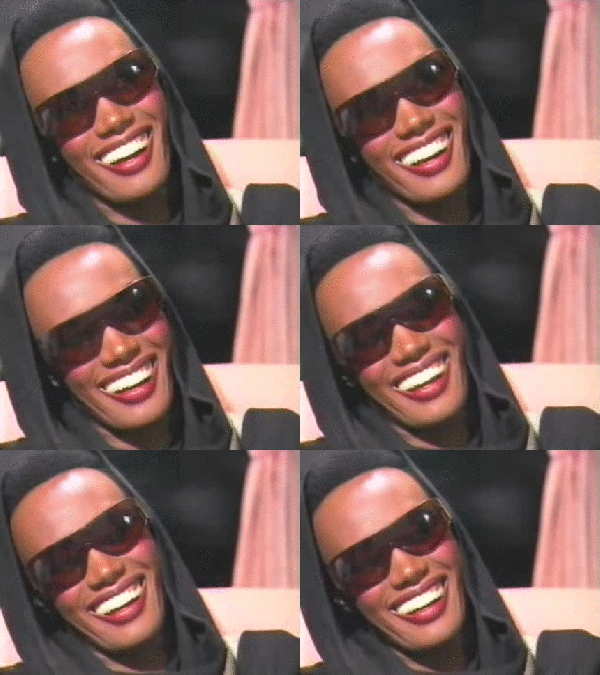
The other thing I related to were Grace’s switchblade-sharp observations on nightclub culture. She discusses the sanctified roots of club music (“…the music that became disco came from soul and funk and therefore gospel.”) and the revolutionary underpinnings of disco, which she calls “a disguised form of militancy.” She makes this claim because of the way disco brought together people on society’s margins (gays, people of color) in the service of creating something life affirming that offered temporary escape from the constraints of the outside world. As she describes one club: “…it would get crazy in there as though everyone was finding themselves by forgetting who they were.”

The book, which can be dense and repetitive at times, isn’t for everyone. But I found the reading experience to be full of payoffs and who-knew moments. For instance, guess which ‘70s slow jam featuring a singer who would become an ‘80s “Quiet Storm” superstar was essential in helping Grace become comfortable with her deep voice? The answer.
Btw, check out my Top 10 Fave Grace songs

 craig's pop life